They Thought They Were Free
I’ve been reading a lot about the rise of the Third Reich - not for fun but because people keep throwing around statements like “this is similar to the lead up in the years before the Holocaust!” and I wanted to find out if there was any truth to the claims.
While the Nazi party was violent out of the gate, there ARE a lot of parallels: window stickers to differentiate a German business from a Jewish one, a slow loss of civil liberties, removal of career positions for those who won’t comply, etc., eventually leading toward the dramatic atrocities we have all heard about.
And of course, the ALL OVER use of propaganda, dumbed down to the lowest common denominator. A “trust the experts” and “us versus them” message. This dumbed down simplicity was a very important part of Hitler's message. He needed to appeal to the broadest possible audience. Have you noticed our "authorities" and "experts" doing the same thing? Dumbing it down. Telling us to "trust the data," "follow the evidence," but never telling us what that data and evidence is?
While I don’t think the Nazi Party and Hinshaw are the same, the unwarranted restrictions and slow creep of power are alarming enough that our ears are to the ground and our passports are valid. The “quarantine” hotels are not legal, and neither is most of what’s happening, which is why if people DO appeal their tickets, they always get thrown out.
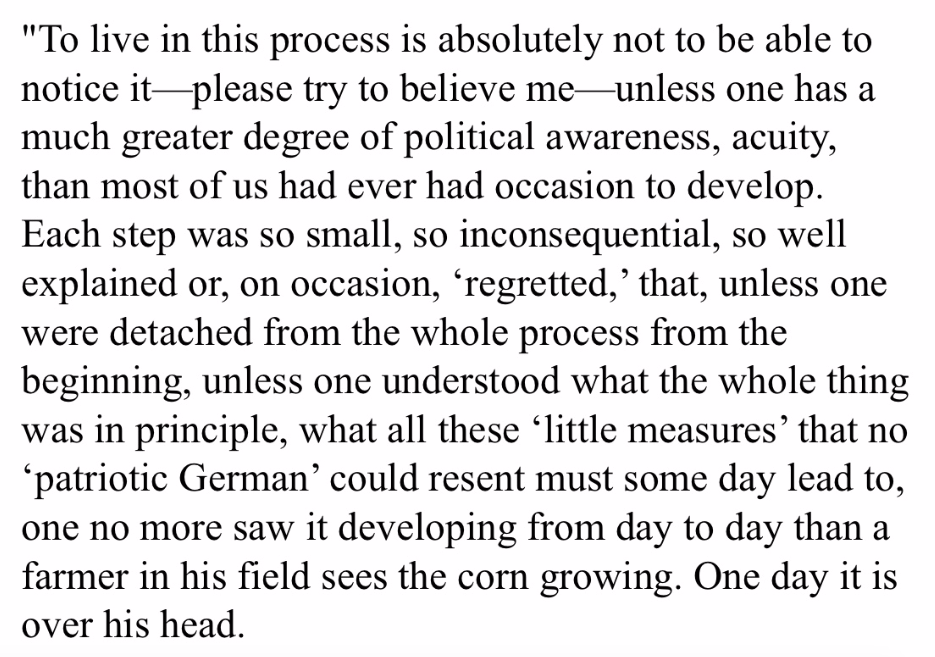
I wanted to include a powerful excerpt from the book "They Thought They Were Free" by Milton Mayer, a journalist who interviewed many "ordinary" Germans after World War II. I will post a few of the most poignant quotes on their own first, then the entire piece. I found this by listening to an absolutely excellent podcast Reflecting History (https://www.reflectinghistory.com). The host, Matt, intertwines well-researched history with psychology, philosophy, human nature, in a way that's beautiful to listen to and very human, discussing the characters of the past as real people, relatable. He challenges his listeners to put themselves in the positions of the people involved, getting us to ask the hard questions such as "would I really have acted any differently given the same situation?"
I have caught myself perhaps getting caught in the hype when I'm online, but then looking out the window at my neighbourhood and thinking "it seems fine. It can't be that bad."
But then I read this, spoken after the Holocaust, by a "normal person," a bystander:

In a number of conversations with my husband, the comment was made, "imagine if they jumped straight from 'two week lockdown' to 'vaccine passports to travel or go to a sports game.' People would have freaked out and it never would have been allowed to happen. But when there is a very slow, steady, long and drawn-out sequence of new rules, new restrictions, some easing up, then more rules and restrictions, people forget. They grow accustomed to things, then they get tired. Then they will just do whatever the authorities want in an attempt to bring back sanity. They're fatigued. We've heard our friends say 'if it'll get things back to normal, jab me now!'"
Then I read this, from the 1940's, and it stopped me in my tracks:
And yet, we keep hoping. Someday it'll be the straw that breaks the camel's back. Humanity will wake up, and there will be unified non-compliance. Widespread civil disobedience. We will take back our lives and our country.
But we are dealing with humans.

Full excerpt here: https://press.uchicago.edu/Misc/Chicago/511928.html

Comments